
Not long ago, I watched a young man unpack a brand-new phone.
He held it with that familiar, universal excitement. The screen glowed. The edges were flawless. For a few moments, it felt as though he were holding the future in the palm of his hand.
And then a strange thought came to me.
In a month or two, that same phone will feel hopelessly outdated. A newer model will emerge — faster processor, sharper camera, brighter screen. What feels indispensable today will quietly become obsolete tomorrow.
It struck me that our culture has built an entire economy around a single word.
New.
A new car. A new house. A new relationship. A new year. A new opportunity.
We invest enormous sums of money — and even more emotional energy — pursuing whatever comes next, believing that just beyond the horizon lies the life we’ve been looking for.
But there is a curious thing about the kind of new our culture celebrates.
It never stays new for long.
Today’s innovation is tomorrow’s clearance item. The excitement fades. The novelty wears off. Time eventually catches up to everything.
The new becomes old.
Or so we’ve been taught.
But what if there is another kind of newness? One that doesn’t fade with time, but actually grows deeper because of it?
Perhaps that is the newness our hearts have been searching for all along.
Two Kinds of New
The ancient Greeks understood a distinction our English language completely hides.
They had two entirely different words for “new.”
The first was neos — something recently made or newly acquired. The presents under the tree on Christmas morning are neos new. The latest smartphone is neos new. The shoes fresh from the box are neos new.
Until next year.
Neos always comes with an expiration date.
The second word was kainos.
Kainos speaks of something altogether different. It describes renewal, transformation, a quality of newness that comes not from being recently manufactured but from being fundamentally changed. Something made fresh through God’s creative and redemptive activity. Not merely newer in time — but renewed in its very nature.
That distinction changes everything.
Most of us spend our entire lives chasing neos.
God invites us into kainos.
The New That Doesn’t Grow Old
One of my favorite passages in all of Scripture comes from Paul’s second letter to the Corinthians:
“Therefore we do not lose heart. Though outwardly we are wasting away, yet inwardly we are being renewed day by day.”
Paul refuses to deny reality. Physically, we age. Strength shifts. Energy fluctuates. Time leaves its fingerprints on every single life.
But Paul also refuses to let aging tell the whole story.
The word he uses for “being renewed” is built directly from kainos — anakainoo. To make new again. To renew continually. Not once. Not occasionally.
Day after day.
What an astonishing vision of human life.
While one part of us grows older, another part is growing newer. The world notices the wrinkles. Grace notices the renewal.
And perhaps the longer we walk this path, the newer our inner life becomes — not despite the passing years, but because of them.
The Wrong Story About Growing Older
Our culture tells a remarkably small and discouraging story about aging.
Your best years are behind you. Your greatest work is done. Your contribution is slowly diminishing.
Henry David Thoreau famously observed that most people live lives of quiet desperation. I’ve often wondered if much of that desperation grows from a single lie — that newness belongs exclusively to the young. There is one short season for becoming, followed by a long season of maintenance, memory, and the management of decline.
Arthur Brooks challenges that story beautifully. In From Strength to Strength, he reminds us that most of us evaluate our lives using what psychologists call fluid intelligence — our ability to think quickly, process information rapidly, and solve unfamiliar problems. These abilities naturally peak early and shift with age. When they do, we panic. We assume we are losing ourselves.
But Brooks points to a second kind of intelligence that continues growing for decades. Crystallized intelligence. Wisdom. Perspective. Judgment. The ability to connect ideas across an entire lifetime. The capacity to encourage, to mentor, to discern, to love more deeply.
Life, Brooks argues, is not a trajectory of simple decline.
It is a trajectory of transformation.
Paul would smile at that insight. Because long before psychologists mapped crystallized intelligence, he was describing something even deeper — not simply becoming wiser, but becoming newer.
The People Who Refused to Peak Early
Scripture and history are full of people who discovered kainos long after the world assumed their story had reached its conclusion.
Moses was eighty years old when God called him into the defining work of his life. Not forty. Not fifty. Eighty — after decades of obscurity, after a long wilderness detour, after everything that looked like a promising beginning had faded into distant memory. His most important chapter was still ahead of him.
Caleb was eighty-five when he stood before Joshua and declared, “Give me this mountain.” Don’t give me a rocking chair. Not give me somewhere comfortable to finish well. Give me the challenge. Give me the hard thing. I am still becoming.
Paul wrote his most insightful words from a prison cell. His physical circumstances narrowed. His spirit expanded in ways that chains could never touch.
And Jimmy Carter — whose presidency many viewed as the endpoint of his significance — spent the next four decades building houses, teaching Sunday school in his small Georgia church, and becoming one of the most admired servants of the modern era. He never stopped believing in new chapters.
None of these people believed that newness belonged only to youth.
They had discovered Kainos.
Lessons from a Butterfly Garden
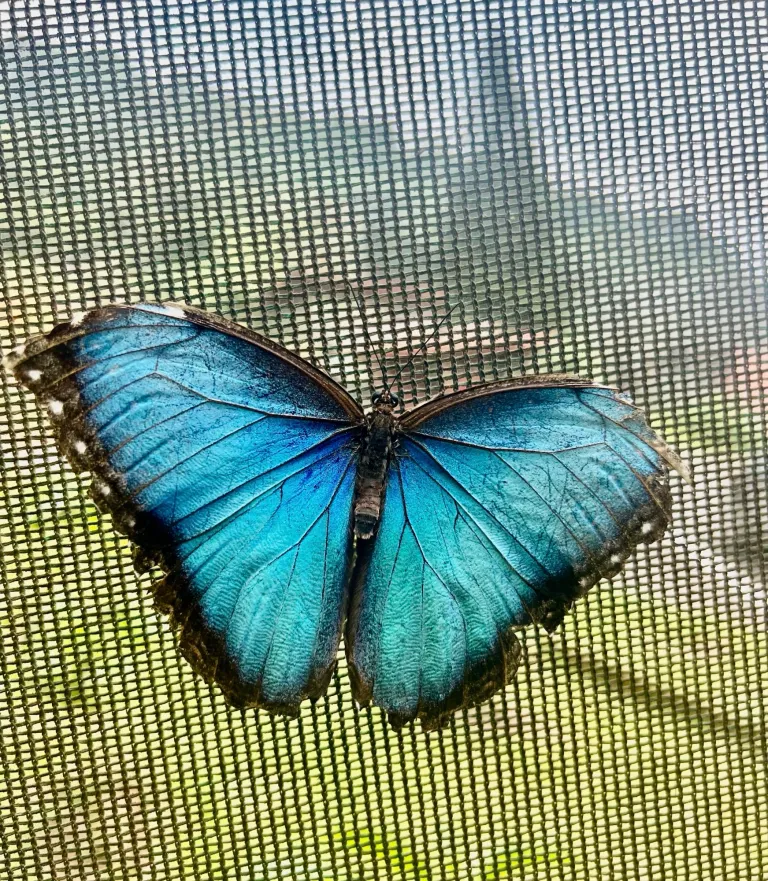
A few years ago, Vickie and I visited a butterfly garden in Costa Rica.
I wasn’t entirely sure what to expect. But nothing prepared me for the sight of hundreds of butterflies in every imaginable color, floating through the warm tropical air. They landed on flowers, on leaves, occasionally on our hands. They moved through that garden as though entirely unaware of how extraordinary they were.
Standing there, it was easy to enjoy their beauty and forget completely what they had been before.
Each of those stunning creatures had begun as an earthbound caterpillar. Between the caterpillar and the butterfly lies the one season most of us instinctively dread and avoid — the chrysalis. The in-between place. The dark, uncertain season where the old form breaks down completely before the new one can emerge.
Inside the chrysalis, something almost miraculous happens. The caterpillar doesn’t simply grow wings. It essentially dissolves — its very structure breaking down into something almost formless — before being reorganized into an entirely new creature. The butterfly doesn’t modify what the caterpillar was. It becomes something the caterpillar could never have imagined from within its old life.
I stood in that garden and thought about that image.
Because I think that is exactly what Kainos looks like in a human life.
Not improvement. Not modification. Not a slightly upgraded version of who we used to be.
Transformation.
The kind that requires passing through something first. The kind that doesn’t happen around the difficult season but through it. The kind that produces something you couldn’t have planned or predicted from where you were standing before.
What strikes me most about metamorphosis is this: the butterfly doesn’t negotiate its timing or skip the chrysalis because it seems too long or too dark. It simply surrenders to what the process requires.
And on the other side of that surrender, it becomes something capable of things the caterpillar could never have dreamed.
I wonder how many of us are living caterpillar lives — not because transformation isn’t available to us, but because we are afraid to enter the chrysalis. Because we resist letting the old forms break down. Because we haven’t yet trusted that what emerges on the other side will be worth the darkness of the in-between.
This is the invitation of Kainos.
Not to preserve the caterpillar.
But to become the butterfly.
Metamorphosis at Every Stage
Here is what that Costa Rica butterfly garden reminded me most powerfully:
Metamorphosis doesn’t check your calendar. It doesn’t review your history or count how many times you have already tried and failed. It doesn’t ask your age or assess your remaining years. It simply requires one thing.
A willingness to enter the process.
This is the very essence of Begin Again.
Not a single dramatic reinvention that happens once and defines everything after. But a sacred rhythm of transformation is available at every stage, in every season, as long as we remain open to it.
What if the season you are in right now — however uncertain, limited, or late it feels — is actually your chrysalis?
What if this is not the end of your story, but the sacred in-between place where your next form is quietly taking shape?
What if becoming is not something that happened to you once, a long time ago, but something happening to you right now — whether you recognize it yet or not?
A Growth Mindset of Grace
Carol Dweck’s research has given us language for two fundamentally different ways of moving through life.
A fixed mindset believes our traits, our capacities, and the essential shape of our lives are carved in stone. Every challenge becomes a terrifying verdict on our worth. Life becomes less an adventure and more an audition, with stakes that feel impossibly high because the judgment feels permanent.
A growth mindset believes in something fundamentally different — that we continue to become. That challenges are invitations rather than threats. That failure is information, not a verdict.
Growth is not merely self-improvement. It is active participation in God’s ongoing work of making us new. The butterfly doesn’t manufacture its own metamorphosis. It surrenders to a process larger than itself. And something it could never have created through effort alone emerges on the other side.
This isn’t positive thinking.
It is possibility thinking.
We are not merely people trying harder.
We are people being made new.
The New That Waits for You
So let me ask you something directly.
Have you quietly assumed your best ideas are behind you? Is that your most significant contribution has already been made? Does the most meaningful chapter belong to your past?
What if that isn’t true?
What if your greatest creativity is still unfolding? What if your deepest wisdom has not yet fully emerged? What if becoming older and becoming newer were always meant to happen together?
That has become my genuine hope. Not that I remain forever young. But I continue to become new. More compassionate. More courageous. More curious. More generous. More fully alive. More like Christ.
I think of those butterflies moving through the garden in Costa Rica — unhurried, luminous, entirely themselves. None of them was mourning the caterpillar. None of them was trying to return to what they had been. They had passed through the chrysalis and emerged into something the caterpillar could not have imagined.
That is what grace offers every one of us.
Not a return to what we were.
But a transformation into what we are becoming.
The world will continue chasing neos.
God continues offering kainos.
One eventually grows old.
The other never does.
So if you have begun to wonder whether your best days are behind you — hear Paul one more time:
Though outwardly we are wasting away, yet inwardly we are being renewed day by day.
That is not wishful thinking.
It is grace.
And grace never stops making people new.
If this reflection encouraged you, I’d love to continue the conversation.
Every Tuesday morning I publish a new Begin Again essay exploring renewal, leadership, faith, and the courage to embrace life’s next chapter.
Join the EnSpirit Community and receive each new essay directly in your inbox.
➡️ Join the EnSpirit Community on Substack
 EnSpirit