
Reflections on America’s 250th Birthday
“The United States themselves are essentially the greatest poem.”— Walt Whitman
A couple of years ago, Vickie and I sailed into New York Harbor.
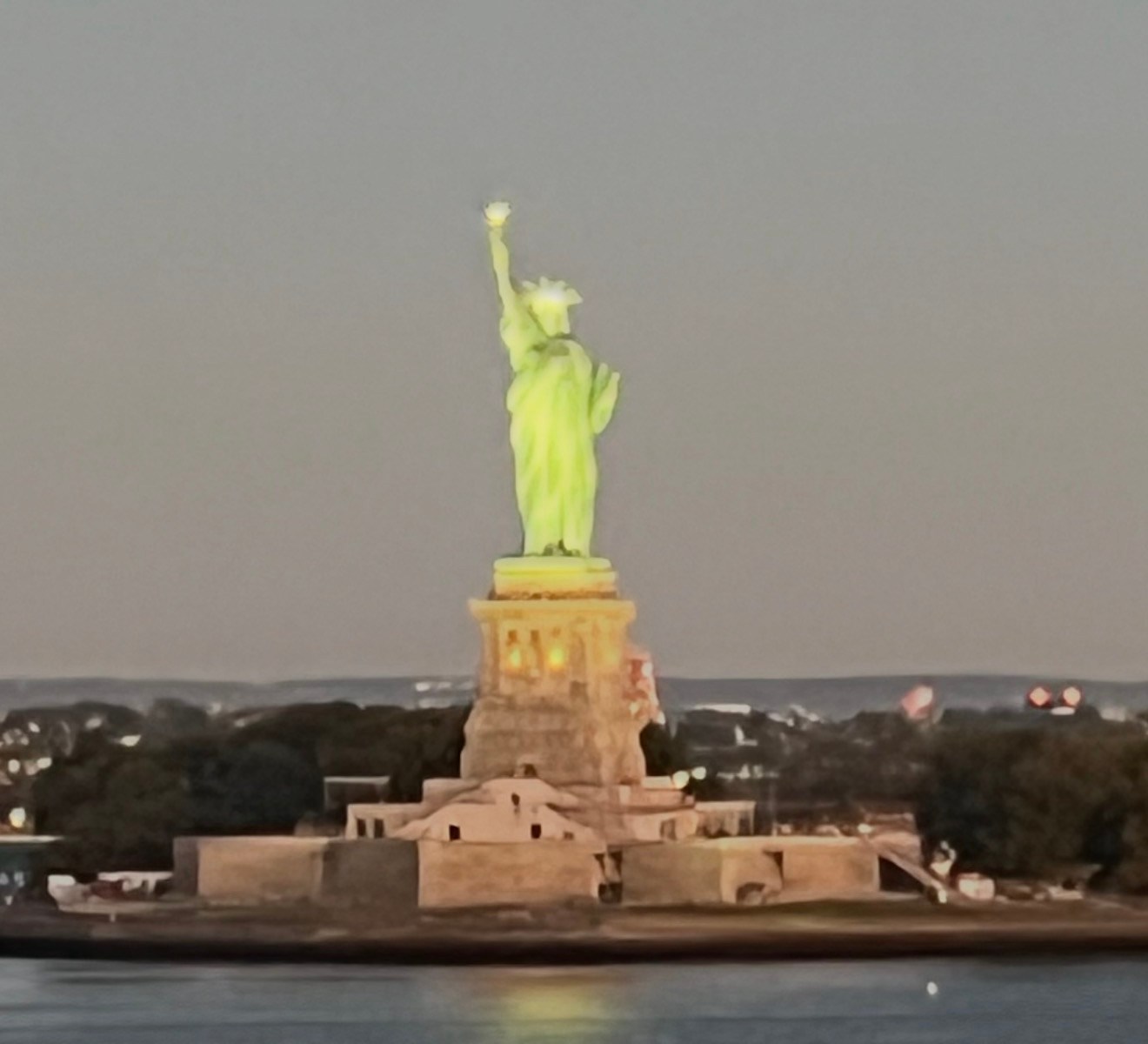
I had seen the Statue of Liberty before, but not from the deck of a ship at dawn. Nothing quite prepares you for the moment she appears out of the early morning mist — torch raised, face turned outward, standing watch over the water as she has for generations.
I stood on the deck of the ship in the quiet of that morning, looking at Lady Liberty, and a question rose in my mind and heart. In the season of deep division and uncertainty that is so prevalent in our country, are we at the dawn of the day, or at its sunset?
I didn’t have an answer. I’m still not sure I do.
But what struck me in that moment was that she wasn’t looking backward. She never has. Her torch is lifted toward the future. Her face is turned toward those still coming, still hoping, still yearning.
And standing there on that deck, I thought of Walt Whitman, who once wrote that the United States is essentially the greatest poem.
I love the comparison, but standing in the harbor that morning, I wanted to finish Whitman’s thought.
America is not simply a poem.
America is an unfinished poem.
That is not an admission of failure.
It is a confession of hope.
A finished poem can only be admired.
An unfinished poem still has room for another verse.
It can surprise us. It can evolve. It can become more beautiful than anyone first imagined.
Perhaps nations are like that.
Every generation inherits the poem.
Every generation receives the pen.
Every generation decides what the next stanza will say.
That means America’s story has never been about perfection.
It has always been about possibility.
We have never fully lived into the promise of those opening words. Our history reminds us of that.
Nearly two hundred and fifty years ago, a small gathering of ordinary people dared to write extraordinary words:
“We hold these truths to be self-evident, that all men are created equal, that they are endowed by their Creator with certain unalienable Rights, that among these are Life, Liberty and the pursuit of Happiness.”
The Declaration proclaimed equality while slavery endured. Women waited generations before their voices could be heard at the ballot box. Native peoples endured profound injustice. Immigrants have often been welcomed with one hand while being pushed away with the other.
Our history contains breathtaking courage alongside heartbreaking failure.
To acknowledge that is not to diminish America. It is to tell the truth.
And every honest poem tells the truth.
What has always given me hope is this: America has carried within itself the language necessary for its own renewal.
Again and again, people have returned to those opening sentences — not to discard them, but to call us back to them.
Frederick Douglass did. Susan B. Anthony did. Abraham Lincoln did. Martin Luther King Jr. did.
None of them argued that the poem should be abandoned.
They believed it should finally be lived.
Lincoln understood this deeply.
Standing in the shadow of a nation torn apart by civil war, he reached back to the Declaration. He reminded us that America had been conceived in liberty, and dedicated to the proposition that all people are created equal.
He understood that the work was unfinished.
In his Second Inaugural Address, he refused the easy language of vengeance. Instead, he gave us one of the most remarkable invitations ever spoken by a political leader:
“With malice toward none; with charity for all…”
Those are not the words of someone writing the final chapter.
They are the words of someone inviting a nation to write a better one.
A century later, another voice echoed that same hope.
Standing before the Lincoln Memorial, Martin Luther King Jr. reminded America that the Declaration had written a promissory note that had yet to be fully honored.
His dream was not rooted in fantasy. It was rooted in possibility.
He believed America could become what it had always claimed to be.
King did not ask us to write a different poem.
He asked us to finish the one we had already begun.
Emma Lazarus’s words are still carved into the base of that statue I watched from the ship deck that morning — still inviting the world to send their tired, their poor, their huddled masses yearning to breathe free.
Notice that word.
Yearning.
The poem is still welcoming those who yearn.
The promise remains unfinished.
And perhaps that is not a cause for despair.
Perhaps, after all these years, it is still a cause for hope.
Sometimes we speak as though America’s greatness lies somewhere behind us.
Others insist that our best days are over.
I believe both misunderstand the nature of hope.
Hope is not nostalgia.
Hope is imagination.
Hope believes another stanza can still be written — another act of courage, another injustice confronted, another child given opportunity, another stranger welcomed, another bridge built across division, another dream imagined.
As we celebrate America’s 250th birthday, perhaps the most patriotic thing we can do is neither defend the past nor despair over the present.
Perhaps it is simply to keep writing.
Lives marked by justice. Communities shaped by compassion. A nation that becomes more generous, more humble, and more faithful to its highest ideals.
Not because perfection is possible.
But because the possibility still is.
The Declaration gave us the opening lines.
Whitman reminded us that we are a poem.
Lincoln taught us to write with humility.
King challenged us to write with courage.
Now the pen rests in our hands.
The poem remains unfinished.
And perhaps that is exactly how it should be.
Because a single generation never finishes the best poems. They are written, line by line, by people who believe hope always deserves another verse.
Happy 250th, America!
As we celebrate 250 years, what gives you hope for America’s next chapter?
 EnSpirit