
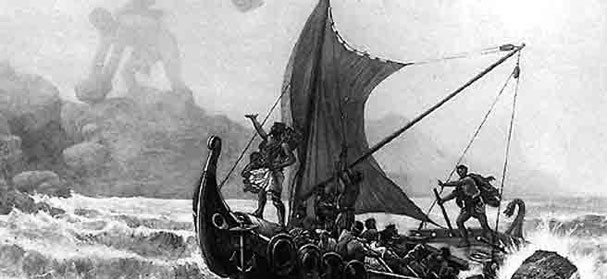

I recently wrote about watching the Odyssey and how Homer’s ancient story is really our story — each of us longing to find our way home. The response was great. So many of you reached out to say you recognized yourself in Odysseus’ journey — the wandering, the longing, the desperate effort to return to something true and real.
But there’s another layer to this story I didn’t mention.
Odysseus doesn’t just journey home. He fails his way home.
He loses ship after ship. He loses every single one of his men. He makes catastrophic decisions driven by pride and anger. He gets trapped for seven years on an island by a goddess who offers him everything — comfort, beauty, even immortality — and he still can’t find his way. He arrives home so broken, so unrecognizable, that even his own family doesn’t know him.
And yet — he makes it home.
That’s the part of the story I want to sit with today. Because I think it’s the part we most need to hear.
The Myth of the Straight Path
We have been sold a lie about the spiritual journey.
The lie goes something like this: if you have enough faith, if you make the right choices, if you follow the right path — your journey will be relatively smooth. Struggle means you’re doing something wrong. Failure means you’ve lost your way. Disappointment is a sign of weakness or lack of faith.
This lie is everywhere. It’s in our churches, our self-help culture, our social media feeds where everyone else seems to be thriving while we’re barely surviving.
But look at the actual stories of scripture.
Abraham lied about his wife — twice. Moses murdered a man and spent forty years in exile before his real calling began. David committed adultery and arranged a murder. Peter denied Jesus three times around a charcoal fire. Paul persecuted the church before he became its greatest missionary.
These are not footnotes to their stories. These are their stories.
The path home has never been straight. It has never been smooth. It has always run directly through the territory of failure, struggle, and disappointment.
What Failure Actually Does
Here’s what I’ve come to believe: failure doesn’t disqualify us from the journey. It prepares us for it.
Every failure strips away something that wasn’t real. Every struggle reveals character we didn’t know we had. Every disappointment loosens our grip on things we were holding too tightly — things that were never really ours to begin with.
Odysseus arrives home a different man than the one who left for Troy. The proud, cunning warrior who thought he could outsmart the gods has been broken open by years of failure and loss. And it is precisely that broken, humbled, weathered man who is capable of reclaiming his home and his kingdom.
The man who left Troy couldn’t have done it. He was too proud, too sure of himself, too convinced of his own invincibility.
It took the failures to make him who he needed to become.
This is what the Apostle Paul understood when he wrote that we glory in our sufferings — because suffering produces perseverance, perseverance produces character, and character produces hope. He’s not celebrating pain for its own sake. He’s tracing the arc of transformation that runs directly through our hardest seasons.
The broken places become the strongest places. Not in spite of the breaking — because of it.
The Danger of Hiding Our Story
But here’s where it gets complicated. Because most of us don’t glory in our sufferings. Most of us hide them.
We are deeply ashamed of our failures. We curate our lives carefully — on social media, in church, even in our closest relationships — to present only the victories, only the successes, only the parts of our story we’re proud of.
And in doing so, we cut ourselves off from the very thing that could set us free.
Odysseus arrives home in disguise. He hides his true identity even from his own family. And as long as he stays hidden, he cannot reclaim what is rightfully his. The moment of homecoming only comes when he is willing to reveal himself — wounds, failures, wandering years and all.
That’s the moment everything changes.
There is something about owning our whole story — including the failures, the wrong turns, the seasons of wandering — that is absolutely essential to reclaiming our true identity. As long as we hide our failures, they own us. When we own them, we are finally free.
Shame keeps us in disguise. Truth sets us free.
The Prodigal’s Path
Jesus told a story that makes the same point.
A young man takes his inheritance, leaves home, and proceeds to waste everything he has on reckless living. He ends up broke, hungry, feeding pigs in a foreign country — about as far from home as a Jewish boy could get, literally and spiritually.
And then scripture says something remarkable: “he came to himself.”
Not when things got better. Not when someone rescued him. Not when he found a way to hide his failure or spin his story. He came to himself in the pigpen, at the bottom, with nowhere left to run.
The failure led him home.
It was the disaster — not the success — that woke him up to who he really was and where he really belonged. And the moment he owned his story, the moment he stopped hiding and started walking home, his father was already running toward him.
This is the gospel hidden inside every failure: our worst moments don’t have to be the end of our story. They can be the beginning of our coming home.
Reclaiming Your True Identity
Here’s what I want you to hear today, wherever you are on your journey:
Your failures are not the final word about who you are.
Your struggles are not evidence that God has abandoned you.
Your disappointments are not proof that you’ve taken a wrong turn.
They are part of the story. They are shaping you into someone you couldn’t have become any other way. And if you will let them — if you will face them honestly instead of hiding from them, own them instead of being owned by them — they will lead you home to your truest self.
Hemingway wrote that the world breaks everyone, and afterward many are strong in the broken places. That is not just poetic observation. That is spiritual truth.
The broken places are not where your story ends. They are where your real story begins.
An Invitation
So wherever you are today — whatever failure you’re carrying, whatever struggle has worn you down, whatever disappointment has left you feeling lost and far from home — I want to offer you this:
Don’t waste it. Don’t hide it. Don’t be ashamed of it.
Your failures and struggles are not detours from your story. They are your story. And the God who met Jacob in his wrestling, who restored Peter after his denial, who transformed Paul on the Damascus road, who ran toward the prodigal while he was still a long way off — that same God is in the middle of your mess right now.
The long way home is still the way home.
Keep walking.
 EnSpirit