
Begin Again Series
By Robert White | Enspirit.blog
I came across the phrase almost by accident.
It was on the jacket of a book I picked up in an airport bookstore—one of those moments when a line finds you before you fully understand why it matters. “The Great Perhaps.” Three words that felt both mysterious and inviting.
The phrase is attributed to François Rabelais, the sixteenth-century monk and writer, and echoed centuries later in John Green’s Looking for Alaska. The phrase captured my attention and imagination.
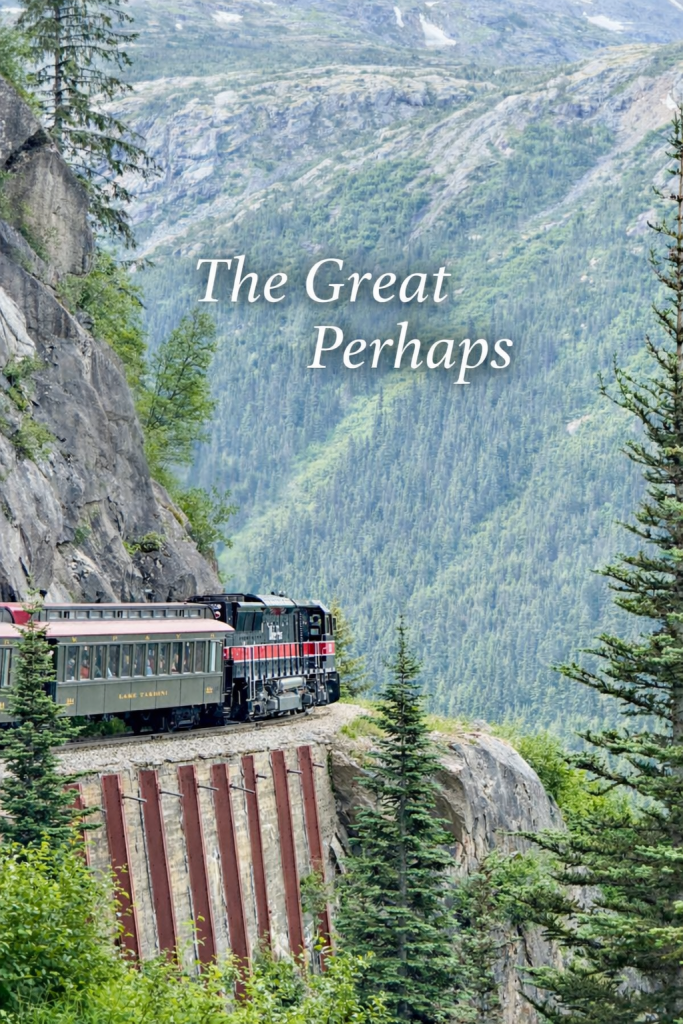
The Great Perhaps.
It stayed with me. It turned over in my mind during quiet times. It felt like an invitation I didn’t quite know how to accept, to something I couldn’t quite name. It felt like a different perspective on life.
And slowly, I began to understand what it was offering.
The Quiet Closing
There are seasons in life when everything begins to feel settled. Not in the sense of peace—not that deep, abiding sense that you’re exactly where you’re meant to be. But settled in the sense of finality. Done. Decided. Fixed.
We fall into routines that weren’t chosen so much as accumulated. We accept certain limits—about ourselves, about our circumstances, about what’s possible at this stage of life. We begin to believe, without quite saying it aloud, that what is now is what will always be.
This is my life.
This is how things are.
This is as far as it goes.
And slowly, without realizing it’s happening, something inside us closes. Not dramatically. Not with a decisive slamming of doors. Just quietly, almost undetected. We stop expecting anything new. We stop watching for possibilities. We settle into the known and call it wisdom, when sometimes it’s just weariness wearing a more respectable name.
I’ve felt this in my own life. Seasons where the days blurred together in comfortable sameness. I allowed routine to become a rut. Where I could predict every conversation, anticipate every outcome, and navigate every challenge with muscle memory instead of attention. It wasn’t terrible. It just wasn’t “alive” in the way I knew life could be.
The Disruption
But now and then—and this is grace—something disrupts that quiet closure.
A conversation that goes deeper than small talk. A moment of rest when you’re finally still enough to hear your own thoughts. A line in a book that stops you cold. A question from a child that you can’t answer with the usual platitudes. A dream you thought you’d outgrown, surfacing again like something rising from deep water.
A whisper of possibility.
And suddenly, unbidden, you begin to wonder: “What if there is more?”
Not more in the sense of accomplishment or acquisition. More in the sense of depth. Meaning. Aliveness. More chapters in a story you thought was finished. More becoming in a self you thought was set.
This is where the Great Perhaps begins. Not with certainty. Not with a plan mapped out in careful detail. But with a question that cracks open what had closed.
The Reopening of Imagination
In many ways, beginning again starts right here. Not with a decision, but with a reopening of the imagination.
A willingness to believe that the future is not fully written. That the script isn’t set. That there are still paths we have not walked, still gifts we have not discovered, still chapters waiting quietly to unfold if we’re brave enough to turn the page.
This isn’t about fantasy or wishful thinking. It’s about something deeper—the refusal to let the past have the final word on the present or future. The choice to hold space for possibility even when the evidence feels thin.
I’ve come to see that one of the great dangers in life is not failure. It’s settling. Settling into patterns that no longer give life. Settling into roles that no longer reflect who we are becoming. Settling into a story that feels finished when it is not.
John Gardner, in his book “Self-Renewal”, observed how easily we accept the status quo, how difficult it is to break free and go beyond it. He wrote about the invisible cages we build for ourselves—made not of bars but of habits, assumptions, and the stories we tell about who we are and what’s possible. And he was right. It takes courage to imagine something different. To believe that change is still available to us, even when we’ve lived a long time in the same shape.
But that is exactly what the Great Perhaps asks of us. It asks us to live as if the story is still open. As if we are still becoming, not just maintaining. As if there is more ahead than we can currently see.
What It Looks Like
On a personal level, this might look like rediscovering something you thought you had outgrown. A creative impulse that got buried under responsibilities. A calling that whispered to you once and then fell silent—or maybe you stopped listening. A desire for something more meaningful than what currently fills your days.
It might look like asking new questions of your own life instead of accepting the old answers:
*What is still possible for me?*
*Where have I stopped growing?*
*What might be waiting just beyond the edges of what I know?*
These aren’t comfortable questions. They disturb the settled dust. They invite risk and uncertainty. But they also invite life.
The Great Perhaps invites us to enter the realm of possibilities. It requires that we revisit our potentials not yet explored.
I think of the people I’ve known who chose the Great Perhaps along the way of life. The lawyer who went back to school at fifty to become a teacher. The businessman who walked away from success to start a nonprofit serving the homeless, trading security for significance. The young person who decides to break with his family’s tradition of being a physician to study literature.
None of them had guarantees. All of them had fear. But they also had something else—a stubborn belief that the story wasn’t over, that there was still more life to be lived.
The Collective Great Perhaps
On a collective level, the Great Perhaps is just as important. Maybe more so.
Every movement toward justice, every act of reconciliation, every vision for a better world begins with someone refusing to accept that the present moment is the final word. It begins with people who look at how things are and dare to imagine how things could be.
Martin Luther King Jr. dreamed of a beloved community when the evidence suggested it was impossible. Dorothy Day served the poor and protested war when everyone told her it wouldn’t make a difference. Every person who has ever worked for change—in their community, their family, their own heart—has had to believe in the Great Perhaps. Had to trust that something new could emerge from what is.
Hope, at its core, is simply the courage to believe in the not yet. To live toward what could be, even while standing in what is.
Living the Invitation
To live toward the Great Perhaps is not to ignore reality. It’s not toxic positivity or spiritual bypassing. It’s not pretending that limitations don’t exist or that change is easy.
It is, instead, to refuse to be defined by present circumstances. To hold space for possibility even when the path is unclear. To trust that something new can still emerge—from the ashes of what’s been lost, from the soil of what’s been planted, from the quiet stirrings of what’s trying to be born.
Beginning again is not always about having a plan. Sometimes it is about recovering the imagination to believe that a new chapter is possible at all. About reopening what had closed. About daring to ask “what if?” when everything around us whispers “this is all there is”.
There is more ahead than we can currently see. More life. More growth. More possibilities. The story is not finished. It never is—not until our last breath, and maybe not even then if you believe in a God who specializes in resurrection.
The Question That Opens
So wherever you find yourself today—whether you feel stuck in patterns that no longer fit, settled into a life that feels too small, or simply uncertain about what comes next—I want to invite you to sit for a moment with this question:
*What might still be possible?*
Not five years from now. Not in some distant future when everything is different. But just beyond the horizon of where you are today. Just past the edge of what you can currently see. What might be waiting there, if you were willing to take one step toward it?
Because sometimes the first step in beginning again is not action. It is imagination. It is the quiet, courageous decision to believe in the Great Perhaps. To live as if the story is still open. To trust that there is more—more life, more love, more becoming—waiting for us if we’re brave enough to reach for it.
The Great Perhaps is not a promise that everything will work out perfectly. It’s an invitation to stop living as if everything is already decided. To reopen what had closed. To step toward a future not yet seen with hope instead of fear.
And that, I’ve discovered, is often exactly what we need to begin again. To enter the realm of the Great Perhaps!
 EnSpirit